



TL;DR
San Diego needs more than 100,000 affordable units by 2030 and is nowhere near on track to deliver them. For architects and developers who understand how to work the finance stack — tax credits, local inclusionary requirements, faith-based land partnerships, and state density law — affordable housing in San Diego is both a civic imperative and a viable practice. AVRP has delivered affordable and mixed-income housing across the city for decades. Here’s how we think about it.
The Affordable Housing Gap: What the Numbers Say
The San Diego Housing Commission estimates the city needs over 100,000 new affordable units by 2030 to meet projected demand. Against that target, the city’s progress — while accelerating on the market-rate side — has been far slower on deeply affordable housing.
The 2025 Point-in-Time Count found no fewer than 9,905 people experiencing homelessness across San Diego County, many of whom require not just housing but supportive services alongside it. Veterans represent a particularly acute segment of this population, facing complex challenges including trauma and chronic illness alongside a lack of stable housing.
The barriers to affordable production are structural: high land costs, construction cost escalation, the length and complexity of the Low Income Housing Tax Credit (LIHTC) application and award cycle, and dependence on federal and state subsidy programs that are both insufficient in scale and unpredictable in timing.
The Finance Stack: What Makes Affordable Projects Work
Every affordable housing project is an underwriting exercise as much as a design exercise. The typical affordable project in California draws on a combination of the following sources:
Funding SourceTypeNotesLow Income Housing Tax Credits (LIHTC)Federal/State equity4% and 9% credits; highly competitive; primary equity source for affordable dealsState HCD Programs (AHSC, IIG, PLHA)State grants/loansCalifornia-specific; require affordability covenantsSan Diego Housing Commission (SDHC)Local loans/grantsFederal CDBG, HOME, and local fundsSan Diego County ProgramsLocal loans/grantsCounty HOME and CDBG allocationsBonds (tax-exempt)DebtOften paired with 4% LIHTC; provides long-term low-cost debtFaith-based land contributionLand equity (YIGBY model)Eliminates land cost; enables no-subsidy development
The YIGBY Model: Building Without the Red Tape
One of the most compelling innovations in San Diego’s affordable housing landscape is the YIGBY (Yes In God’s Backyard) model — pioneered locally with the involvement of AVRP Founder and CEO Doug Austin, FAIA, who serves as Chair of the YIGBY Advisory Board and Steering Committee.
YIGBY unlocks underutilized faith-owned land — church parking lots, surplus parcels — for affordable housing development without government subsidy. By eliminating land cost from the equation, the model allows projects to be built faster, at lower cost per unit, and with fewer bureaucratic constraints than subsidy-dependent alternatives.
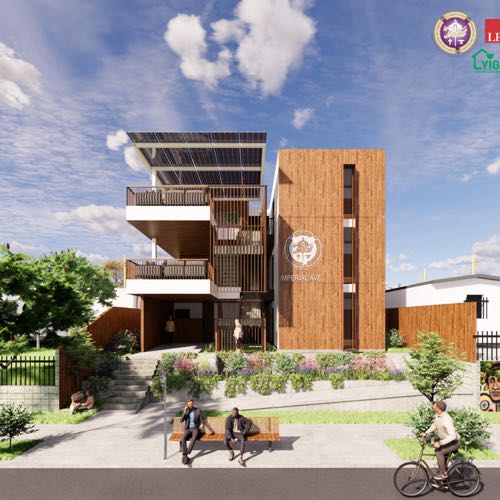
AVRP’s work on the Imperial Lofts YIGBY project on Imperial Avenue near Bethel AME Church is the proof of concept: 26 one-bedroom units for formerly homeless veterans, on church land, without government subsidy, designed pro bono by AVRP. “Without the subsidy, you don’t have the red tape, and it doesn’t cost as much to build,” Austin said.
AVRP’s Affordable Housing Portfolio in San Diego
Across more than three decades of affordable housing work, AVRP has designed projects spanning every income tier and financing structure:
- Los Vientos Affordable Housing — affordable family housing in San Diego
- MAAC Ivy — affordable housing developed with Metropolitan Area Advisory Committee
- Imperial Lofts YIGBY — faith-based infill housing for veterans, Grant Hill
- Kettner Crossing — 64 affordable units for seniors, Little Italy, developed with BRIDGE Housing and the County of San Diego
- 7th and Market — 400+ affordable units in downtown San Diego, constructed by Chelsea (under design)
- Two Community HousingWorks projects (under design) — following the award-winning Portola Senior Apartments partnership, which won a PCBC Gold Nugget award
What Makes Affordable Projects Succeed: AVRP’s View
After decades of affordable housing work, AVRP’s principals have a clear-eyed view of what separates the projects that get built and succeed from those that stall or disappoint:
- Design quality is not a luxury in affordable housing — it’s a community obligation. Residents of affordable housing deserve the same quality of design, light, space, and outdoor access as any market-rate resident. Projects that compromise on these dimensions fail their residents and fail the neighborhood.
- The finance structure drives the design timeline as much as the design itself. Architects on affordable projects must understand LIHTC award cycles, construction deadline requirements, and the consequences of missed milestones. AVRP’s experienced team has navigated these timelines on projects across the city.
- Density is the affordability engine. Whether through Complete Communities FAR tiers or state density bonus, maximizing unit count on a given site is the primary lever for improving project economics. Design that squanders height or density potential makes the underwriting harder, not easier.
Key Takeaways
- San Diego needs 100,000+ affordable units by 2030; the YIGBY model, LIHTC, and Complete Communities density tools are the primary pathways to accelerating production.
- AVRP has delivered affordable housing across all income tiers and financing structures in San Diego, from YIGBY veteran housing to LIHTC senior apartments to large-scale mixed-income communities.
- Affordable housing requires the same design quality and commitment as any project — and AVRP’s nearly 50-year track record reflects that standard.
If you are a developer, nonprofit, or faith-based organization working on an affordable housing project in San Diego, let’s talk.
Sources
- AVRP Studios. YIGBY Press Release: Nears Completion of First Affordable Housing Project. June 2025. avrpstudios.com
- San Diego Housing Commission. Affordable Housing Need in San Diego. sdhc.org
- Regional Task Force on Homelessness. 2025 Point-in-Time Count, San Diego County. rtfhsd.org
- California Department of Housing and Community Development. Low Income Housing Tax Credit Program. hcd.ca.gov
- YIGBY. Yes In God’s Backyard — About the Initiative. yigby.org